In June 2025, the Securities and Exchange Commission formally withdrew fourteen proposed rules, among them the conflicts-of-interest proposal on predictive data analytics by broker-dealers and investment advisers — the closest thing our profession had to a dedicated AI rule. The Commission was explicit that any future action in that area would require starting the rulemaking over.
Around the same time, the profession’s adoption of AI accelerated. We are now in an unusual position: absorbing a powerful technology into fiduciary work faster than the rules governing it are being written.
Into that vacuum, real guidance has begun to arrive. On February 19, 2026, the U.S. Treasury released a shared AI Lexicon and the Financial Services AI Risk Management Framework, developed through the Financial and Banking Information Infrastructure Committee and the Financial Services Sector Coordinating Council’s AI Executive Oversight Group, and published in full by the FSSCC. It adapts the NIST AI Risk Management Framework to the operational, regulatory, and consumer-protection realities of financial services. It is a serious document — 230 control objectives mapped across the AI lifecycle, drawing on input from more than a hundred institutions, agencies, and regulators.
But read it closely and you notice what it is: a framework for governing the model. Is the system inventoried, validated, monitored, documented? Is the vendor diligenced? These are the right questions. They are not the only question.
What the current frameworks largely leave open is the layer where AI stops predicting and starts recommending. The layer where an output becomes advice.
That layer is where our entire profession lives. And it is close to ungoverned.
I came to this problem from an unusual direction. I trained as a physician before I built technology for advisors, and medicine has already lived through exactly this transition — the arrival of powerful analytic tools into work where a wrong answer harms a person who trusted you. Medicine did not solve it perfectly. But it solved it durably, and the solution is sitting in plain sight for anyone in wealth willing to borrow it.
When does AI output become financial advice?
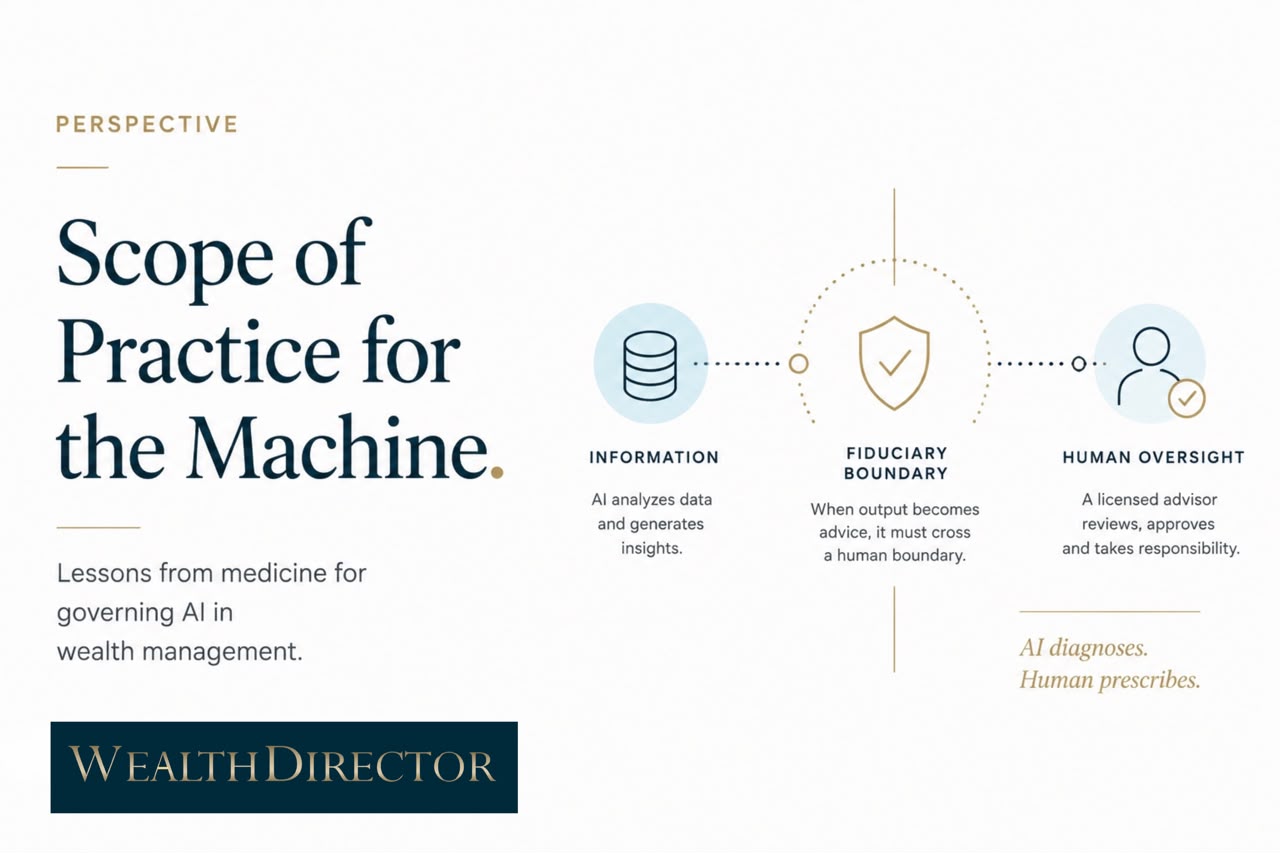
Start with the distinction that organizes everything in a clinical setting: the difference between information and advice.
A diagnostic machine can tell you what is. It can read the scan, flag the anomaly, compute the risk score. That is information, and information is allowed to be powerful. What the machine cannot do — what it is structurally not permitted to do — is write the prescription. The moment an output crosses from “here is what I observe” to “here is what you should do about it,” authority transfers to a licensed human. That boundary is not a courtesy. It is the load-bearing wall of the entire system.
Now hold that up against advisory AI.
A tool that surfaces a concentration risk, models a scenario, or flags a contradiction between a client’s stated goal and their actual portfolio is producing information. A tool that tells the client to sell the position, change the allocation, or restructure the trust is producing advice. The first can reach the client freely. The second cannot — not because a regulation currently forbids it, but because giving advice is a fiduciary act, and fiduciary duty does not lapse because the entity forming the recommendation happens to be a model.
This is the line the current frameworks don’t draw, and it is the one that matters most. Governing the model tells you the engine is sound. It tells you nothing about whether the car should be allowed to steer.
Why human oversight of AI should be architectural
Here is the part the industry most needs to hear, and the part that is easiest to get wrong.
In medicine, the rule that a licensed clinician stands between the diagnostic tool and the patient is not enforced by asking people to be careful. It is enforced architecturally. The authority to prescribe is inseparable from who is legally permitted to act. You cannot toggle it off on a busy afternoon. It does not depend on the discipline of the weakest quarter or the most overworked Friday. It is a boundary the system will not let you cross.
That distinction — between a guideline the model is asked to respect and a boundary it cannot cross — is the whole game in advisory AI.
Most firms, if they govern AI at all, govern it with policy: a document stating that AI-generated recommendations will be reviewed before they reach clients. That is better than nothing. It is also only as strong as human compliance under pressure, which is to say, weakest at the exact moments it matters most.
A policy is a promise. What fiduciary work requires is a property — something true of the system whether or not anyone is watching, and provable after the fact.
The design principle is simple to state and demanding to honor: the human sign-off on advice should be built into the system as a boundary, not layered on as a rule. The AI diagnoses. The human prescribes. And “the human prescribes” should be a fact about the architecture, not an aspiration in a compliance manual.
Five controls, borrowed from the bedside
Once you accept that framing, five familiar clinical controls translate almost directly. None is exotic. All are things wealth management already half-does and could do deliberately.
1. The attending sign-off
In a teaching hospital, a resident can work up a case, but the attending physician signs before it becomes a course of treatment.
The advisory equivalent is straightforward: every prescriptive output — every recommended action — routes to the registered advisor for review before it reaches the client. Approve, edit, or reject; the judgment stays human.
This does not require new rules to justify. For registered investment advisers, the compliance rule under the Advisers Act (Rule 206(4)-7) requires written policies reasonably designed to prevent violations — and the Commission has long treated failure to supervise as a distinct basis for liability. For broker-dealers, FINRA Regulatory Notice 24-09 made the parallel point directly: FINRA’s rules are technology-neutral and apply to generative AI just as to any other tool, so the supervisory system required under Rule 3110 extends to AI-assisted work.
Different rulebooks, same conclusion. The supervisory duty was already there. AI simply makes it easier to quietly evade — which is precisely why it should be structural.
2. The chart
Medicine runs on a merciless documentation standard: if it isn’t charted, it didn’t happen. Every observation, decision, and sign-off leaves a durable, timestamped, tamper-evident record.
Advisory AI needs the same — a reconstructable account of what was recommended, on what basis, and who approved it, captured at the moment of decision rather than reassembled under subpoena. This isn’t novel in principle; the books-and-records rule under the Advisers Act (Rule 204-2), and FINRA’s recordkeeping obligations on the brokerage side, already demand a trail.
What’s new is the difficulty. Capturing the reasoning behind a machine-influenced recommendation at the moment of inference is genuinely hard, and I’ll say plainly that most of the industry — ourselves included, in the honest accounting — has further to go here than anyone’s marketing admits. That it is hard is not a reason to skip it. It is the reason to start now.
3. Decision support, not the decision
Clinical decision-support systems operate under a strict brief: surface information to support the clinician, never to replace their judgment.
The framing matters more than it appears to. A system designed to inform a fiduciary is a different artifact than one designed to be the fiduciary — even when the underlying model is identical. The design question is not “can the model produce a recommendation?” It can. The question is “what is it permitted to do with one?” At the recommendation layer, the answer should always route through a person.
4. Differential diagnosis at intake
Good medicine begins by systematically surfacing and ruling out competing explanations rather than anchoring on the first plausible one.
The advisory equivalent is a structured intake that captures goals, risk, current status, and preferences — and actively looks for contradictions among them, the way a clinician reconciles a patient’s stated history against their actual presentation.
This is not merely good service. It is the operational form of an obligation that already exists — the duty of care an adviser owes under its fiduciary obligation, and the care obligation of Regulation Best Interest on the brokerage side. Under either standard: you cannot act in someone’s best interest if you never took their full history.
5. Scope of practice, and the adverse-event protocol
Two controls in one.
Scope of practice governs who — and what — is permitted to see and do what. In software terms: disciplined, role-based access, applied to machine actors as rigorously as to human ones.
And every serious clinical system has an adverse-event protocol: a defined path for what happens when something goes wrong, with clear escalation and a final human authority. AI systems making consequential contributions to advice need both — as first-class features, not afterthoughts.
I’d add a sixth, quieter one: sometimes the strongest control is a deliberate exclusion. A platform that does not take custody of client assets and does not execute transactions has, by design, removed an entire category of risk from the board. In medicine we call the discipline of never losing track of who holds what the chain of custody. In wealth, choosing to hold nothing is a legitimate and underrated way to keep it intact.
Which AI outputs require human review?
The obvious objection is that routing everything through a human defeats the purpose of the technology. It would — which is why the line shouldn’t be drawn at “everything.” It should be drawn by consequence.
Think of two independent axes. One is impact: how much is at stake in a given output. The other is oversight: how tightly a human is bound into it. The principle connecting them is the information-versus-advice distinction already described.
- Anything prescriptive or fiduciary — anything constituting advice — requires human approval before it reaches a client.
- Anything that organizes or presents a client’s own data gets human review before it is relied upon.
- Anything purely factual, read-only, or internal can run inside hard guardrails without a per-output gate.
Notice what is not on either axis: dollar amount.
The gate is fiduciary materiality, not transaction size. A small recommendation is still advice; a large data query is still just information. Sizing oversight to the nature of the act rather than the size of the account is what keeps the framework both safe and usable. It puts the friction exactly where the duty is, and nowhere else.
Conservative by default
I’ll close with the posture underneath all of it, because it’s the part I’d most want a fellow builder or a diligent RIA to take away.
When the SEC withdrew its predictive-analytics proposal, one reading was that the pressure was off — that human-in-the-loop requirements had become optional. We read it the opposite way.
The withdrawal of a rule does not withdraw the duty the rule was attempting to codify. Fiduciary obligation predates every AI framework and will outlast the current deregulatory season. So the right default, wherever a capability’s safety is ambiguous, is the more conservative construction — not because a regulator is watching, but because defensibility is a property you want to be able to prove long after the fact, in a world where the rules will eventually be rewritten and applied to what you built years earlier.
That is really the whole argument. Governance-first is not a brake on AI in wealth management. It is the precondition for anyone — clients, regulators, the advisors themselves — trusting AI enough to let it do the ambitious things it is actually capable of.
Medicine learned that lesson the hard and expensive way, over a century, through harm it could have prevented. Wealth management has the rare privilege of learning it on purpose, before the harm, while the frameworks are still being written.
Five questions to ask an AI vendor about human oversight
If you take one thing from this, take these:
- Does a licensed human review every prescriptive output — and is that enforced by the system, or by a policy?
- Is there a tamper-evident record of what the AI recommended, and on what basis?
- Can that reasoning be reconstructed and explained months later?
- Where exactly is the line between information and advice drawn — and who drew it?
- When the system errs, what happens?
A vendor who can answer those crisply is thinking about the recommendation layer. A vendor who cannot is selling you a model and leaving you the liability.
The AI diagnoses. The human prescribes. A profession with a fiduciary duty at its center should want it no other way — and shouldn’t wait for a rule to require it.